
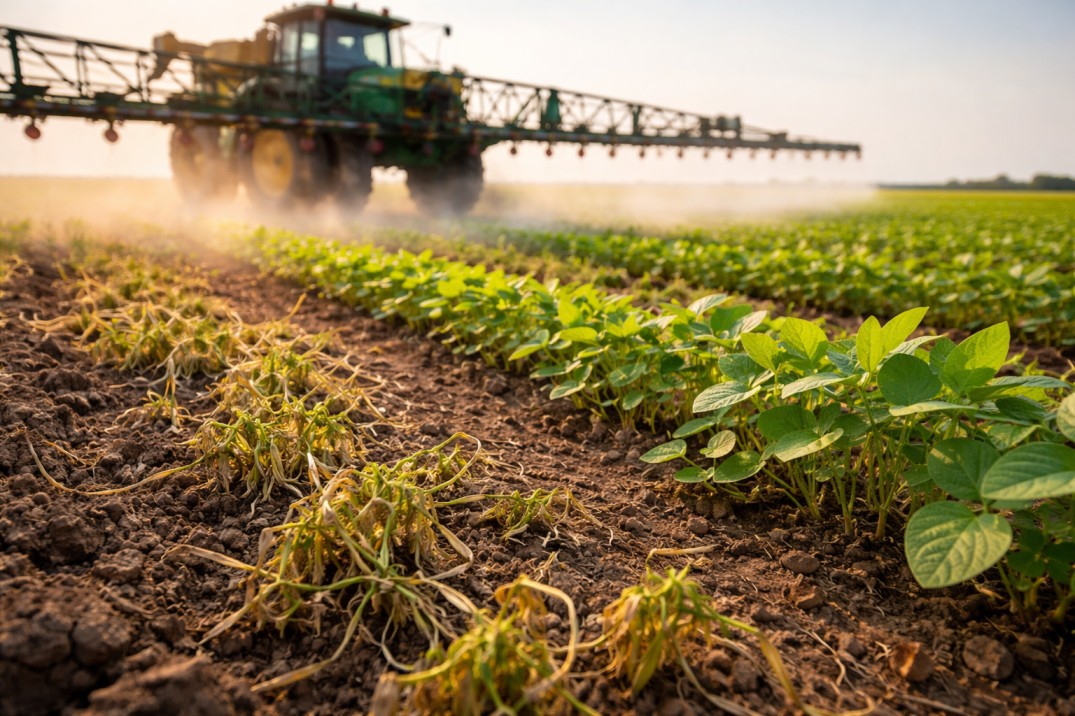
Field pea acres remain prevalent across Western Canadian crop rotations. There are good reasons to grow peas; they produce strong market value and offer excellent rotational benefits. Along with those advantages come unique weed management challenges that are worth understanding. When growing pulse crops year after year, growers can unknowingly exert significant resistance-selection pressure by repeatedly using the same crop types and herbicide groups. Early-season weed competition can also silently steal yield potential well before you realise it’s happening in the field. The foundation for managing these issues begins before the crop even comes up.
Crop competitiveness is relative and peas are notably weak in the early season. They take longer to canopy than cereals or canola and they don’t suppress emerging weeds very well. As a result, the first three to four weeks of growth are critical in pea crops. If weeds emerge at the same time, they will steal available moisture, nutrients and sunlight when the crop needs these resources most. Early weed pressure doesn’t have to be severe to have an impact at harvest; when soil moisture is limited, even a few weeds can result in quantifiable yield loss.
Growers already face a resistance challenge in pulse rotations. Resistant kochia, cleavers, wild mustard, volunteer canola and grassy weeds like wild oats continue to impact Western Canadian growers. When selective pressures are high because the same herbicides are used repeatedly or in-crop options are limited, weeds will adapt to survive. Resistance management is why building programs with a strong pre-seed burndown and residual protection should be considered critical stewardship.
Effective pre-seed burndown eliminates weeds that have already emerged before you seed your crop. Getting ahead of the competition as early as possible gives pea crops a better opportunity to develop without stress. It also leads to cleaner seedbeds and more uniform emergence across the field. The challenge is that burndown doesn’t provide residual protection after weeds have been sprayed. If soil conditions are moist in the spring, it’s common to see new weeds flush once the crop is in the ground. Pre-emergent residual activity helps guard against this.
GoldWing is one tool that provides broadleaf and grassy weed control that can be problematic in pea rotations. Because it has pre-emergent activity and can be applied pre-seed, growers can extend the weed control window beyond burndown. This is important for controlling emerged weeds and suppressing new flushes that occur after seeding. Layering residual options like GoldWing with other pre-seed burndown products helps suppress weeds longer during the most vulnerable stages of pea development.
Integrating herbicides for peas like GoldWing into your pre-seed program can benefit your pea crop in several ways:
First, getting weeds early protects yield potential. Competition early in the season is easily underestimated, but weeds that emerge with your crop will always have the biggest impact on yield. Pre-seed burndown eliminates what’s already there and residual herbicides help control subsequent flushes as the crop establishes.
Second, it takes the burden off your in-crop applications. When there are fewer weeds at emergence, there will be less pressure on an in-crop spray to perform. Not only does that improve overall control, but it also minimises the risk of resistant survivors. From a resistance management standpoint, diversifying weed control across as many Modes of action (MOAs) and timings as possible is one of the best strategies.
Finally, thinking beyond the current season supports your entire crop rotation. While you may be growing peas this year, they will likely be followed by canola and/or cereals. A single crop shouldn’t define selective pressure; it moves throughout your entire rotation. Including residual herbicides as part of a system approach can help reduce selection on valuable herbicide groups and prolong their effective life.
Localised weed pressure helps determine which weeds to target. Dryer brown soil areas may struggle more with kochia or Russian thistle, while dark soil with more moisture will see more cleavers, wild mustard and volunteer canola. Some grassy weeds, such as wild oats, are prevalent across most pea-growing areas. Building a pre-seed burndown program that accounts for local factors will improve results and enhance stewardship.
GoldWing and other residual tools should fit into a larger program of crop protection products. Most growers aren’t looking for a silver bullet solution that solves all their weed problems. They are looking for ways to layer cultural tactics, rotation planning and multiple herbicide chemistries to create a stronger, more diversified program. Pre-seed burndown followed by residual activity is one of the most effective tactics to build into that program.
Weed resistance is an ongoing issue that will continue to evolve with every passing season. Rather than waiting until problem weeds emerge in-crop and limit your control options, start the season on a firm footing with pre-seed burndown and residual protection. Investing in the foundation of your weed management program will reduce variables, set your crop up for success and help safeguard your yield potential.